
Dalian Zhenghe Pump Industry Co., Ltd
contacts:Eyan
mobile phone:+8613942611612
Landline:0411一84245612
email:395904452@qq.com
URL:www.dlzhby.com
address:No. 17 Yutan Street, Ganjingzi District, Dalian City, China
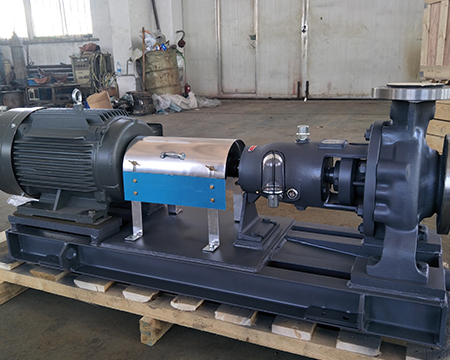
Dalian acid‑resistant pumps serve as core equipment for transporting corrosive media in chemical, environmental‑protection and metallurgical industries. Dry‑running refers to abnormal operation where the pump chamber contains no effective process medium (only air or a small amount of volatile, nearly‑dried acid) and fails to reach rated flow conditions. Most damage induced by dry‑running is irreversible and may lead to total pump scrapping. Specific failures are listed below:
First, irreversible damage to mechanical seals and shaft‑seal assemblies. Acid‑resistant pumps mostly adopt mechanical seals, which rely on liquid films between sealing faces for lubrication, cooling and sealing. During dry‑running, no liquid film forms; rotating and stationary rings undergo direct dry friction, generating instantaneous temperatures of hundreds of degrees Celsius — far exceeding the thermal resistance of silicon carbide, tungsten steel and other sealing materials. Thermal cracking, seizure‑induced deformation or fragmentation occurs on seal faces. Such damage cannot be repaired; full seal‑assembly replacement is required. For stuffing‑box seals, dry‑running causes rapid carbonization and hardening of packing, which loses elasticity and sealing capacity, while abrading the anti‑corrosive coating on the pump shaft. Irreversible shaft wear enlarges sealing clearances and triggers medium leakage, calling for shaft turning‑down or replacement.
Second, accelerated cavitation and corrosion of wetted parts. Under dry‑running conditions, suction‑side pressure drops well below rated values and induces cavitation: dissolved gas precipitates into bubbles under low pressure, which violently collapse when pressure rises inside the chamber. High‑frequency shock and micro‑jets continuously strike wetted surfaces of impellers and casings, causing pitting and erosion on metallic components within a short period, as well as delamination and perforation of non‑metallic wetted parts such as FRP casings. Meanwhile, prolonged medium residence raises acid concentration via evaporation and intensifies local corrosion, further deteriorating wetted components. At one chlor‑alkali plant, accidental dry‑running of a hydrochloric‑acid pump caused impeller cavitation perforation and local casing corrosion within merely 8 minutes. Combined cavitation‑corrosion damage is irreversible; material loss on wetted parts completely ruins hydraulic performance and renders the pump incapable of meeting design delivery requirements.
Third, irreversible deformation of the shaft system and bearings. Impellers of acid‑resistant pumps are designed for axial‑force balance under normal operating conditions. Dry‑running eliminates medium‑driven pressure balance, and axial force surges to 3‑5 times its rated value. Bearings endure excessive axial loads, leading to plastic deformation, indentation and wear on races and rolling elements, or even cage fracture. Unbalanced axial force plus dry‑running‑generated heat bends the pump shaft. Once bending exceeds allowable limits, rigidity and concentricity cannot be restored by simple straightening. Severe vibration emerges during operation and accelerates component wear. This irreversible shaft‑system failure critically impairs core transmission structures.
Fourth, thermal‑deformation failure of pump casing and impeller. Without process medium to dissipate frictional and mechanical‑loss heat during dry‑running, heat accumulates rapidly and sharply raises temperatures of casing and impeller beyond material thermal‑deformation thresholds (approx. 400 °C for cast‑iron casings, 800 °C for stainless steel). Metallic parts thermally expand and deform, destroying impeller dynamic balance. Deformed impellers scrape against casing inner walls and may even seize. For non‑metallic pumps, thermal deformation causes casing cracking and impeller fragmentation. Such structural damage cannot be repaired; full replacement of casing‑impeller assemblies is mandatory.
In summary, irreversible damage from dry‑running of acid‑resistant pumps stems from combined effects of friction without medium, heat accumulation and force imbalance. It not only results in equipment scrapping but may trigger safety accidents due to medium leakage. Complete anti‑dry‑running interlock shutdown protection shall therefore be configured to eliminate dry‑running conditions.
ADDRESS:No. 17 Yutan Street, Ganjingzi District, Dalian City, China
Mobile Phone:139-4261-1612
URL:www.dlzhby.com

